
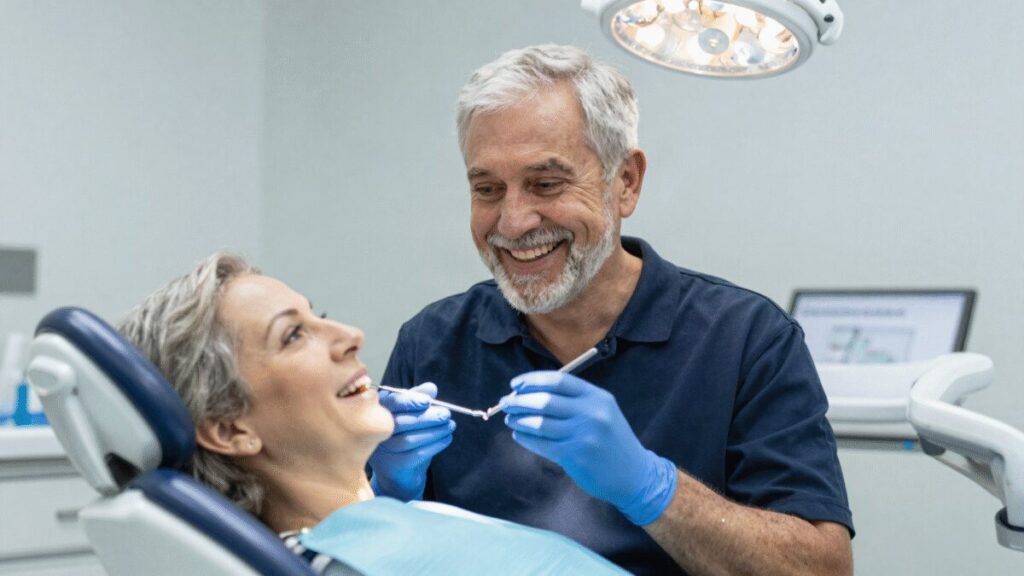
Direct answer: In most cases, no. Original Medicare does not pay for routine dental care like cleanings or dentures, so you pay the full bill. Does Medicare cover dental at all? Yes, in a few narrow cases where the dental work is tied to a covered medical treatment. Many Medicare Advantage plans also add dental extras, each with its own limits.
Fall Open Enrollment runs October 15 to December 7, 2026. Dental shows up in a lot of the ads you will see this season. That makes it a good time to ask a plain question. Does Medicare cover dental care, or does a private plan?
If you are reading this at the kitchen table, worried about a parent’s teeth or your own, take a breath. You have more choices than the TV ads suggest. None of them requires a fast decision.
Original Medicare pays for doctors and hospitals. Teeth were left out from the start. This guide covers the narrow cases where Medicare does pay and what those cases cost in 2026. It also shows how to judge a dental extra before you switch plans.
What are your dental coverage options with Medicare?
Medicare has parts, and dental lives in different places depending on the part. Original Medicare is Part A (hospital) plus Part B (medical). Medicare Advantage, also called Part C, is a private plan that replaces Original Medicare for your care. Medigap is a private policy that helps pay your share of Original Medicare costs.
Outside Medicare, you may also qualify for Medicaid, buy a standalone dental policy, or join a discount plan. These work in very different ways when you get to the dentist’s front desk.
Swipe sideways to see every column.
| Coverage type | Pays for routine dental? | What to know |
|---|---|---|
| Original Medicare (Part A and Part B) | No | Pays only narrow medical exceptions |
| Medicare Advantage (Part C) | Often, as an extra | The plan sets the yearly cap and network |
| Medigap | No | Only helps with services Medicare already covers |
| Medicaid | Depends on your state | Adult dental is optional for states |
| Standalone dental insurance | Yes, within limits | Waiting periods and yearly caps apply |
| Dental discount plan | Pays nothing | Lower prices at member dentists, not insurance |
Why does Original Medicare leave out your teeth?
The dental exclusion is written into federal Medicare law. CMS restates it in its rules. In plain words, Medicare does not pay to care for, fill, remove or replace teeth, except in narrow cases.
The Medicare & You 2026 handbook puts most dental care on its list of things Medicare does not cover. Hearing aids and routine physicals are on that same list. Dentures count as routine dental work too. They are not a hospital benefit under Part A or a medical benefit under Part B.
In my 18 years in insurance marketing, I have seen ads blur the line between Medicare and a private plan’s dental extra on purpose. The law has not changed. What changed is how the extra gets sold.
What does Medicare.gov say it will pay for in 2026?
The Medicare.gov dental services page describes two kinds of cases. In both, the dental work supports your medical care.
- Hospital stays. Medicare may cover some dental services when you are admitted as an inpatient for the procedure. This happens when your health condition or the type of procedure means you need hospital care.
- Work linked to a covered treatment. Medicare can pay when the dental care is needed for another covered treatment to succeed.
Medicare.gov gives examples like these:
- An oral exam and dental treatment before a heart valve replacement or an organ transplant
- Pulling a tooth to clear a mouth infection before chemotherapy
- Treating a complication from head and neck cancer treatment
- Dental exams before and during dialysis if you have End-Stage Renal Disease
Medicare is paying to clear an infection so a medical treatment can work. It is not paying to rebuild your smile afterward with a crown or denture.
What you pay when Medicare does cover it
Regular Part B rules apply. The CMS 2026 fact sheet sets the Part B deductible at $283 a year. After that, you usually pay 20% of the amount Medicare allows. If the work happens in a hospital outpatient setting, the facility may charge you a copayment too.
Here is a worked example. Say your doctor wants an infected tooth pulled before chemo. For easy math, say Medicare allows $500 for the work. That is a round number for practice, not a real fee.
Swipe sideways to see every column.
| Step | Amount |
|---|---|
| Part B deductible, if not met yet this year | $283.00 |
| Left over after the deductible | $217.00 |
| Your 20% of $217 | $43.40 |
| Your share before any facility copay | $326.40 |
If the dental work is part of an inpatient hospital stay, Part A costs apply. The Medicare Costs 2026 guide lists a $1,736 deductible per benefit period. Days 61 to 90 cost $434 a day. Lifetime reserve days cost $868 a day.
Original Medicare alone has no yearly cap on what you pay. You also keep paying the Part B premium of $202.90 a month. People with higher incomes pay more. For example, a single person with 2024 income above $109,000 and up to $137,000 pays $284.10.
The fine print that trips people up
The rules above sound simple. In real life, three things often stop the claim.
- The dentist must be enrolled in Medicare. Many dental offices are not. Ask before the visit.
- The doctor and dentist must work together. Medicare wants records showing the dental care was linked to your medical treatment. Without that paper trail, the claim can be denied.
- Medigap will not fill the gap. Medicare.gov’s Medigap pages say these policies generally do not cover dental care. If Medicare says no to a cleaning, so does Medigap.
Medicare Advantage plans must cover the same narrow medical exceptions. But they can add rules, like using network providers or getting approval first.
Is a Medicare Advantage plan the answer for dental?
You will hear it often: switch to Medicare Advantage and get dental. Sometimes that works. Often it falls short, and the reason depends on what your mouth needs.
Medicare.gov says most Advantage plans offer extras like dental. That is a plan feature, not a federal benefit. Extras can change every year.
When the extra can help
If you mostly need checkups and cleanings, a plan’s dental extra can cover them well. Those visits matter. The National Institute of Dental and Craniofacial Research says dry mouth is not a normal part of aging. Hundreds of medicines can cause it, and less saliva means more decay. Regular exams catch problems early.
When it falls short
Dentures and implants are where plans get tested. Many plans set a yearly dollar cap on dental. Once you hit it, you pay the rest. Some plans also make you wait months before they cover major work, or limit you to network dentists.
Your plan’s yearly out-of-pocket limit covers Part A and Part B services. Dental extras may sit outside that limit, with their own cap. Check the plan’s Evidence of Coverage, not the TV spot.
When you already have Medigap
Be careful before you drop Medigap for a dental extra. Medicare.gov warns that you may not be able to buy a Medigap policy again later. Outside certain rights, insurers in most states can turn you down or charge more based on your health. A dental cap is a small reason to give up strong medical coverage.
Where the money goes
Here is what I know from the lead generation side. Medicare Advantage plans pay agents and brokers commissions under CMS rules. Call centers and lead sellers get paid to bring those agents callers. Standalone dental plans and discount cards often pay sellers too.
Dental makes a strong hook because it is easy to picture. A smiling face sells faster than a network list. The ad shows the smile, but the cap and the waiting period are in the plan documents.
None of this makes a plan bad. It means you should ask any seller how they are paid. Then read the plan documents yourself.
Related: compare all your choices in our guide to dental coverage for seniors in 2026, learn how to choose senior dental plans, and see what else Medicare skips in assisted living costs in 2026.
Six moves before you sign up for dental coverage
- Ask if the work is medical. If a doctor needs your mouth cleared before surgery, chemo or dialysis, start with your medical team. Ask them to find a Medicare-enrolled dentist.
- Get a written treatment plan. Ask your dentist to list each procedure with its code and price. This is your shopping list.
- Call the dentist’s office. Ask if they take the exact plan you are looking at. Plan websites can be out of date.
- Read the dental section of the plan papers. Look for the yearly cap, waiting periods, how often items get replaced, and approval rules. A free counselor at your State Health Insurance Assistance Program (SHIP) can help you read Advantage plan papers.
- Do the math. Say a plan caps dental at $1,500 a year and your plan costs $4,000. At least $2,500 is yours. These are practice numbers. Use your own.
- Check low-cost options. Ask your state about Medicaid adult dental. Dental schools and community health centers often charge less. If you have money in a Health Savings Account, IRS Publication 969 says you can still spend it on dental care after you join Medicare.
What not to do
- Do not give your Medicare number to someone who called you out of the blue about dental benefits.
- Do not delay Part B for a dental sales pitch. Part B has its own late penalty.
- Do not buy under pressure. A real plan will let you read the terms first.
- Do not treat a discount card as insurance. It pays nothing toward your bill.
Frequently asked questions
Does Medicare cover dentures?
No, Original Medicare does not cover dentures in most cases. Dentures are treated as routine dental care, so you pay the full cost. Some Medicare Advantage plans offer denture benefits as an extra. Check the yearly dollar cap and any waiting period first, because a full denture plan can involve several visits over months and may cost more than the cap.
Will Medigap pay for my dental work?
Generally, no. Medigap helps pay your share of costs for services Original Medicare already covers, like the 20% coinsurance. Routine dental care is not covered by Original Medicare, so Medigap has nothing to add to it. If you have Medigap and want routine dental coverage, look at a standalone dental policy, retiree coverage, or Medicaid if you qualify.
Does Medicare pay for a tooth pulled in the hospital?
Sometimes. Medicare may pay for dental work done while you are a hospital inpatient, if your health or the procedure means you need hospital care. It may also pay to pull a tooth that has to come out before a covered treatment like chemo. Being in a hospital alone does not make a routine extraction covered. Your doctors need to document the medical link.
Can I use HSA money for dental after I join Medicare?
Yes. IRS Publication 969 says you cannot add new money to a Health Savings Account once you are on Medicare. But you can still spend the money already in the account on qualified medical costs, and dental care counts. Keep your receipts in case the IRS asks. This can help pay for work that no plan covers.
Does Medicaid cover dental for people with Medicare?
It depends on your state. If you have both Medicare and full Medicaid, Medicare pays first and Medicaid may cover some things Medicare does not. Medicaid.gov says states do not have to cover adult dental. Some states cover routine care. Others cover only emergencies. Call your state Medicaid office to find out.
Your next step
Start with your dentist and ask for a written treatment plan with prices. Then check each plan’s dental cap and network against that list before you sign anything. If you are thinking about switching plans this fall, you have until December 7 to compare.

Sources