
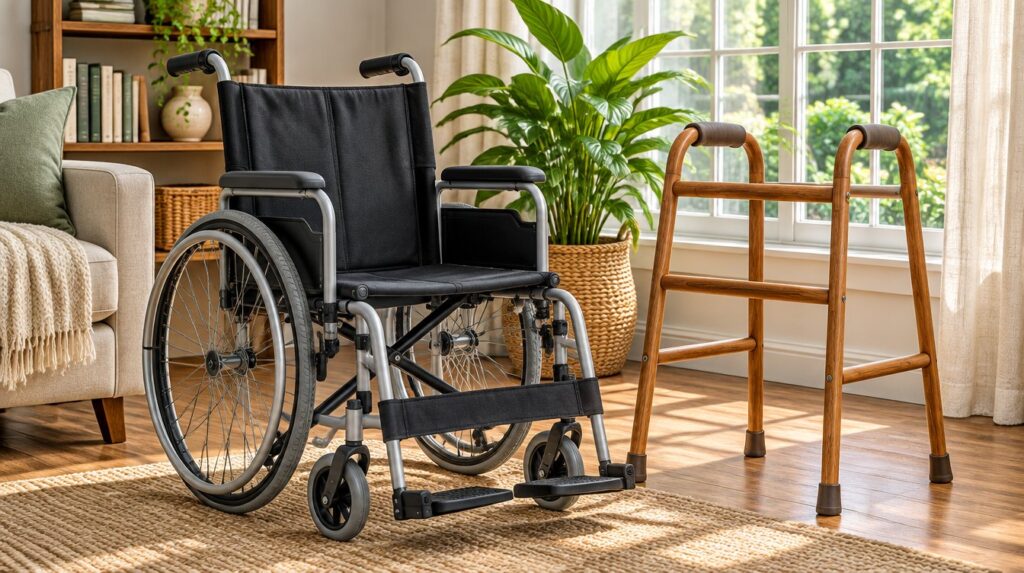
Direct answer: Does Medicare cover wheelchairs? Yes, Medicare Part B can cover a wheelchair, scooter, or walker when it is medically necessary and ordered for use in your home. After you meet the 2026 Part B deductible of $283, you pay 20% of the amount Medicare allows if the supplier accepts assignment. Power wheelchairs and scooters also need a face-to-face exam and a written prescription. Medicare pays only if you use a supplier enrolled in Medicare.
People often buy a wheelchair from a nearby store and hope to send Medicare the receipt later. That usually fails. The program treats this equipment as durable medical equipment, or DME, with supplier and paperwork rules that start before the item arrives.
What kind of equipment can Part B help pay for?
Medicare groups wheelchairs and scooters with other durable medical equipment used at home. The wheelchairs and scooters page and the walkers page both say Part B covers the item if you qualify. Both describe the same cost rule. After the Part B deductible, you pay 20% of the amount Medicare allows.
Walkers include rollators when you qualify. Hospital beds follow the same DME pattern. CMS also publishes a booklet, Medicare Coverage of Durable Medical Equipment and Other Devices.
Depending on the item:
- You may need to rent it.
- You may need to buy it.
- You may be able to choose rent or buy.
- Some rented items become yours after a set number of rental payments.
Hospital beds are commonly rented, and some rented items become yours after a set number of payments. Walkers are more often purchased. Ask the supplier which rule applies to the exact item on the order.
The equipment has to be for use in your home. A doctor or other provider must order it. Wanting a scooter for the mall is not the test. The test is medical necessity for getting around in your home.
What extra steps do power wheelchairs and scooters require?
Part B covers power wheelchairs and scooters only when they are medically necessary. Medicare.gov says you must have a face-to-face exam and a written prescription from a treating provider. That step comes before Medicare covers a power wheelchair or scooter.
Some power wheelchairs also need prior authorization. The DME supplier should request that review and send the documents to Medicare. You usually do not file that packet yourself. Medicare reviews whether you meet the coverage rules.
A prior authorization request may be denied if Medicare finds you do not medically need the power wheelchair. It may also be denied if the file does not have enough information. The supplier can resubmit if more records are needed.
A manual wheelchair can still be the right device when a power chair does not meet the home-use test. Ask the provider which one they can support in the medical record.
What will you pay in 2026?
Medicare.gov’s 2026 cost page lists the Part B deductible as $283, then usually 20% of services and equipment Medicare allows. The same 20% after the deductible appears on the wheelchair and walker pages.
If the supplier participates in Medicare, they must accept assignment. That means they can charge you only the coinsurance and the Part B deductible for the amount Medicare allows.
A supplier that does not participate does not have to accept assignment. If they refuse assignment, you can be charged more. For rented DME, make sure the supplier will accept assignment for every rental month. Otherwise you may have to pay the full rental up front and wait for Medicare to reimburse its share later.
Here is a worked example. The sample allowed-amount figure is an illustration so you can see the coinsurance math, not a published national price for a specific chair.
A person has already met the $283 Part B deductible this year. Medicare approves $1,000 for a manual wheelchair from a participating supplier. The person owes 20%, which is $200. If they had not yet met the deductible, they would pay the remaining deductible first, then 20% of what is left.
If home health care is also in place, the visits themselves can cost $0, while the equipment still follows this 20% rule. That split is spelled out on Medicare’s home health page and in does Medicare cover home health care.
A Medigap plan may pay that 20% for assigned claims, depending on the lettered plan. An Advantage plan can use different copays and a network of DME suppliers. Check the plan before the supplier orders the item.
What fine print leads to surprise bills?
Enrollment beats a store aisle price. Medicare will pay for DME only when you get it from suppliers enrolled in Medicare. Ask for the supplier’s Medicare enrollment and whether they accept assignment, before they take a deposit.
Home use is required. Equipment meant only for getting around outside the home is a common reason for a denial. Describe how you move inside the house: bathroom, bedroom, kitchen.
Repairs have their own path. For a walker you already own, Medicare.gov says you can use any Medicare-enrolled supplier to make repairs, including replacement parts needed for the repair.
Disaster rules can change temporarily. If you live in an area that has been declared a disaster or emergency, the usual rules may change for a short time. Medicare.gov notes that this can include how you replace lost or damaged equipment.
A medical alert device is not a wheelchair. Personal emergency response systems are a separate buy and are usually not paid by Original Medicare. See medical alert systems for seniors.
Part B premiums are separate from the 20%. You still pay the monthly Part B premium, which is $202.90 in 2026 for most people, whether or not you order equipment. Details are in Medicare Part B premiums and IRMAA.
If the larger question is whether you can stay at home with helpers instead of moving, use home care vs assisted living.
Five moves before you accept a delivery
- Ask the provider to write the order for home use and to include why a cane or walker is not enough if they are ordering a wheelchair or scooter.
- Choose a Medicare-enrolled supplier that accepts assignment and, for a rental, will accept assignment every month.
- For a power chair or scooter, complete the face-to-face visit and ask the supplier whether prior authorization applies.
- Get the expected out-of-pocket amount in writing, including the deductible if you have not met it yet.
- Inspect the item on delivery and keep the order, the delivery slip, and any prior authorization decision.
What not to do
Do not let a salesperson upgrade you to a power scooter in the parking lot without a provider’s written order. Do not pay the full cash price “just to be safe” at a non-enrolled store if you intend to use Medicare. And do not assume that qualifying for home health care automatically includes a chair. The equipment still needs its own order.
I built this site after watching my grandmother stretch SNAP and Medicare until she passed at 87. Shopping for a wheelchair is stressful enough without surprise bills. I wrote the supplier rules first because that is where people get stuck.
Frequently asked questions
How much of a wheelchair does Medicare pay?
If the item is covered and the supplier accepts assignment, Medicare pays its share of the amount Medicare allows after you meet the $283 Part B deductible. You pay the remaining 20%. A Medigap policy or Medicaid may cover that 20% if you have one of those.
Does Medicare cover a walker or rollator?
Yes, Part B covers walkers, including rollators, when they are medically necessary and ordered for use in your home. The cost rule is the same 20% after the deductible if the supplier accepts assignment. Repairs to a walker you own can go through any Medicare-enrolled supplier.
Why would Medicare deny a scooter?
Common reasons include lack of medical need for home use. Other gaps are no face-to-face exam, no written prescription, a supplier that is not enrolled, or a prior authorization file that is missing information. The supplier can resubmit when records are missing.
Do I rent a wheelchair or buy it?
It depends on the item. Medicare.gov says some DME is rented, some is purchased, and some lets you choose. Certain rentals become yours after enough payments. Ask the supplier which rule applies to the code on your order.
Can I buy a wheelchair online and file a claim?
Only if that seller is a Medicare-enrolled DME supplier and the other coverage rules are met. Many online listings are not enrolled in Medicare. Check enrollment and assignment before you enter a card number or pay a deposit.
Your next step
Talk with the provider who knows how you move around the house. Ask whether a walker, a manual wheelchair, or a power device is the item they can order for home use. Then call a Medicare-enrolled supplier and ask whether they accept assignment. If you are also being set up with nurses or therapists at home, keep the two benefits separate. Read does Medicare cover home health care so visit coverage and equipment coverage do not get mixed together.

Sources
- Medicare.gov: Wheelchairs and scooters.
- Medicare.gov: Walkers.
- Medicare.gov: Hospital beds.
- Medicare.gov: Home health services (including 20% for DME).
- Medicare.gov: Medicare costs (2026).
- CMS booklet: Medicare Coverage of Durable Medical Equipment and Other Devices (11045).
- CMS: 2026 Medicare Parts A and B premiums and deductibles.